
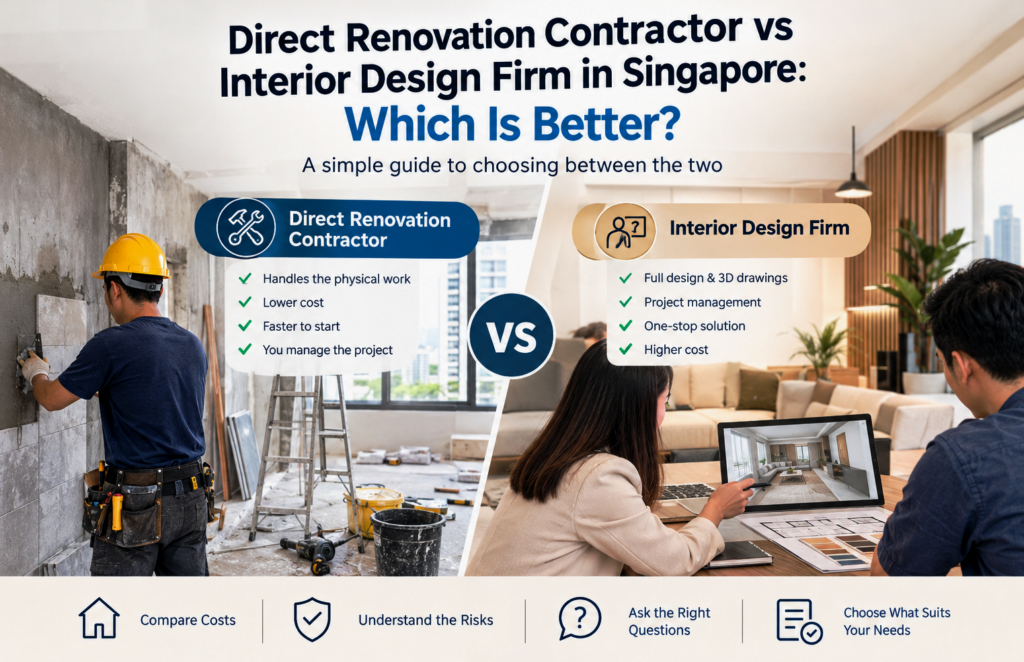
A simple guide to choosing between the two
Home improvement can be quite the challenge and quite the thrill in Singapore. One of the big questions that you’ll inevitably have when you’re doing a home improvement project is whether to go with a direct renovation company or whether to go with interior designers.
Many articles say “contractors are cheaper, IDs are easier” and leave it there. That is true, but it does not help you decide. The better question is this:
How much of the work and risk do you want to handle yourself?
Let’s go through the options in plain terms.
Table of Contents
ToggleWhat a Direct Contractor Does
A direct contractor does the physical work: hacking, tiling, carpentry, electrical, plumbing and painting. You tell them what you want, they give a quote, and they build it.
Contractors usually do not offer much design help. Some will suggest ideas, but you should not expect 3D drawings or detailed layouts. When you choose a contractor, you must be ready to manage the project yourself.
What an Interior Design Firm Does
An ID firm sells design and project management. Most firms act as a one-stop solution, covering ideas, design concepts, project management and vendor coordination. Many also give you 3D drawings so you can see the result before work starts.
Here’s something many homeowners are unaware of. The ID firms themselves don’t generally do the actual work. They will employ contractors or sub-contractors to do the work. So when you engage an ID you’re effectively paying a contractor’s rate plus a fee for design and management.
How Much More Does an ID Cost?
There is no fixed rate, and sources differ. Some put the design fee at around 5% to 10% of the renovation budget. Others say hiring an ID can add roughly $3,000 to over $15,000 to an HDB project. Another guide puts the total markup at 20% to 30%, which is likely because the markup is often hidden inside carpentry prices.
To put this in context, the Consumers Association of Singapore (CASE) guidebook lists typical HDB 4-room costs at $40,300–$62,300 for a BTO flat and $55,700–$80,400 for a resale flat. So even a 10% fee on top is a real amount of money.
My advice: do not compare the headline numbers only. Ask each firm to show what is included. A cheap quote with missing items is not cheap.
Side-by-Side Comparison
| Direct Contractor | Interior Design Firm | |
| Cost | Lower | Higher (design and management fee) |
| Design help | Very little | Full concept, layout, 3D drawings |
| Who manages the trades? | You | The firm |
| Speed to start | Fast | Slower (design rounds first) |
| Best for | Simple, clear jobs | Big, complex or first-time projects |
| Biggest risk | You make costly mistakes | You overpay or the design is not what you wanted |
The Real Test: Who Carries the Risk?
Here’s the way I’d decide.
Choose a direct contractor if:
- Your work is pretty much the same as painting, flooring, a kitchen update or a wardrobe.
- You already know precisely what you want, right down to the materials and the layout.
- You’ve got time to go and visit the site, check the progress and deal with the little issues.
- You have renovated before.
Choose an interior design firm if:
- It is your first renovation.
- You want to knock down walls, redo the layout or change many things at once.
- You are busy and cannot be on site often.
- You find it hard to imagine a finished space from a quote.
Reasonable sources agree on this split. If you are not well versed in renovation and it is your first time, an interior designer to guide the process may be the wiser choice. And for simple, well-defined work, a good HDB-registered contractor can carry it out without design input.
Do Not Forget the Middle Option: Design and Build
Many homeowners miss this one. Design and build firms are a hybrid, and the exact scope varies from firm to firm. They design and build under one roof, which can cost less than hiring an ID and a contractor separately.
The trade-off: firms that started as contractors are often stronger in construction than in design. Look at their past projects to judge whether their style suits you.
Safety Checks That Matter More Than the Choice Itself
Whichever route you pick, a bad firm will cause more trouble than the wrong type of firm. Do these checks first.
- HDB flat? Use a registered contractor. Only contractors in HDB’s Directory of Renovation Contractors can carry out renovation works in HDB flats. If you use an ID, make sure they use registered contractors. Also note that HDB does not endorse or guarantee the quality of their work.
- Look for CaseTrust accreditation. CaseTrust contractors are required to protect your deposit with a performance bond which will help you in the event that the firm goes bust.
- There’s no official licence for interior designers here, so the title alone tells you very little. Before you sign anything, ask to see past projects, read what earlier clients have said, and if possible, speak to one or two of them directly.
- Never pay too much too early. A common guide is 10% on signing, 40% when work starts, 40% at 70% completion, and the last 10% two weeks after everything is done properly. One family in the news paid 90% upfront and their kitchen job dragged from six weeks to five months.
- Get an itemised quote. Ask every firm to quote the same scope so you can compare fairly.
Questions to Ask Before You Sign
- Who exactly will do the work, your own team or sub-contractors?
- What is the total price, and what is not included?
- Is the design fee separate, or hidden inside carpentry prices?
- What happens if the work is late or has defects?
- Can I speak to a recent customer?
A good firm will answer these calmly. If someone gets defensive, take that as a warning.
So, Which Is Better?
Neither is better for everyone. A direct contractor is better when your job is simple and you are willing to manage it. An interior design firm is better when your job is complex or you want peace of mind.
If you’re still not sure, here’s a straightforward middle ground: get quotes from one ID firm, one design and build firm and one direct contractor for the same scope. Put them all side by side and the difference in price, in detail and in the quality of the communication will usually be obvious.
And remember the cheapest quote is rarely the cheapest outcome. A well managed project at a reasonable price is far better than a low price that then turns into delays and repairs.